
Storm Damage Restoration in Clearwater Beach
24/7 storm damage restoration in Clearwater Beach, FL. IICRC-certified, insurance billing accepted. Call (813) 829-1091.
Our IICRC-certified technicians are dispatched from our Thonotosassa, FL headquarters and are typically on-site in Clearwater Beach within 60 minutes of your call.
Clearwater Beach sits on a narrow barrier island where Gulf storms don’t just pass through, they stall, saturate, and leave behind a layered mess of wind damage, storm surge intrusion, and debris that can take weeks to fully unpack. When a squall line crosses Pinellas County and your roof is missing shingles or a palm has come through a lanai screen, the clock starts immediately. Salt air accelerates corrosion on exposed framing, and Florida’s humidity means secondary moisture damage can begin within 24 to 48 hours of the initial event. DRYCOR RESTORE responds around the clock, dispatching from Thonotosassa with the equipment and IICRC-certified training to stabilize your property before the damage compounds.
Why Clearwater Beach Properties Are Especially Vulnerable to Storm Damage
Barrier island geography creates a specific storm damage profile that inland properties rarely face. Clearwater Beach is bounded by the Gulf on the west and Clearwater Harbor on the east, which means wind-driven rain and surge can approach from multiple directions during the same storm. Homes and condominiums here are often built on elevated slabs or pilings to meet coastal flood zone requirements, but that elevation doesn’t protect roof assemblies, windows, or screen enclosures from the lateral force of sustained tropical-system winds.
The building stock on the island ranges from mid-century concrete block cottages to post-2000 high-rise condominiums, and each presents different vulnerabilities. Older concrete block homes can develop hairline cracks in the block itself after repeated storm stress, creating moisture pathways that don’t show up until mold has already colonized the interior wall cavity. Newer construction generally performs better structurally, but impact-resistant windows and doors still fail under direct debris strikes, and flat or low-slope roofs common on commercial and resort properties collect standing water quickly when drains are overwhelmed by heavy rainfall.
Our Storm Damage Restoration Process in Clearwater Beach
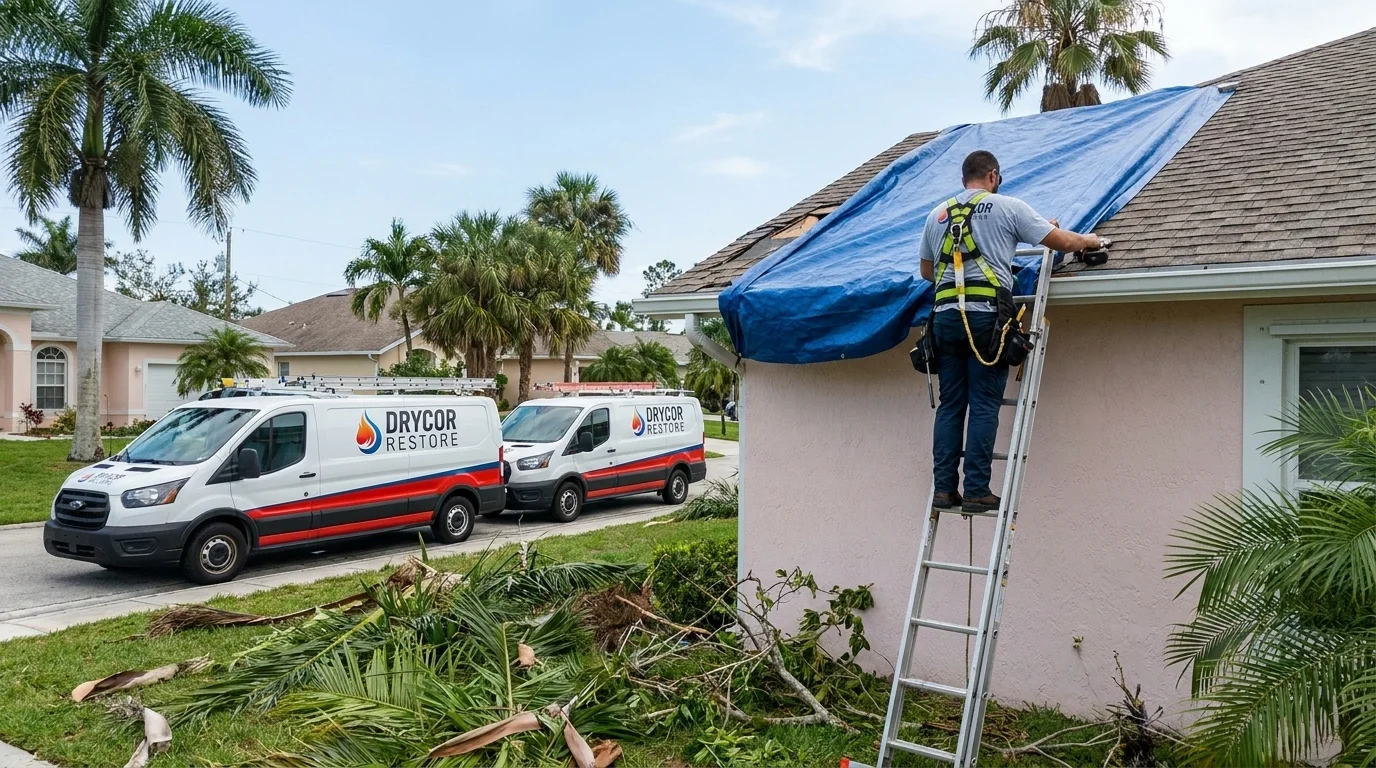
The first priority after any storm is stopping active intrusion. That means emergency tarping of compromised roof sections, boarding or temporary glazing of broken windows, and pumping or extracting any standing water before it migrates under flooring or into wall assemblies. On Clearwater Beach, salt content in storm surge water is an added variable, saltwater is corrosive to metal fasteners, electrical components, and HVAC systems in ways that freshwater flooding is not, so affected materials are documented and assessed differently.
Once the structure is stabilized, the drying phase begins. We use calibrated drying equipment and monitor moisture readings throughout the process, following IICRC standards to confirm that structural materials reach acceptable moisture levels before any reconstruction begins. Clearwater Beach’s ambient humidity, especially in the months following a summer storm, means dehumidification loads are higher than in drier climates, and drying timelines reflect that reality rather than a generic estimate.
Documentation runs parallel to every step. Photographs, moisture logs, and scope notes are compiled in a format that supports insurance claims from the first day on site.
Clearwater Beach Insurance and HOA Coordination
Many properties on Clearwater Beach carry both a standard homeowners or commercial policy and a separate wind or flood policy, and the interaction between those two policies is one of the most common sources of claim confusion after a storm. DRYCOR RESTORE documents losses in a way that clearly separates wind-driven damage from water intrusion, which matters when a carrier needs to assign portions of a claim to different policy types.
Condominium associations on the island add another layer. HOA master policies often cover the building envelope while unit owners are responsible for interior finishes, and the boundary between those two can be disputed after a storm event. We communicate directly with property managers and association boards when the scope of work crosses that line, so the remediation doesn’t stall while ownership questions get sorted.
Reaching Clearwater Beach from Thonotosassa
From DRYCOR RESTORE’s base in Thonotosassa, the primary route to Clearwater Beach runs west on SR-60 across the Courtney Campbell Causeway, which connects Tampa Bay’s eastern shore to Clearwater and continues across the Memorial Causeway onto the island. Because Clearwater Beach is accessible by a limited number of causeways, post-storm traffic and debris on those routes can affect arrival logistics. We account for that in dispatch, and because we operate 24/7, we can often move before peak post-storm traffic builds.
Local Note
One detail that matters specifically on Clearwater Beach: the island’s stormwater and drainage infrastructure can be overwhelmed quickly during a major rain event, and standing water in streets and parking areas sometimes delays access to ground-floor units and commercial spaces even after the storm itself has passed. If your property has a ground-level entry or below-grade parking, it’s worth knowing that the water visible outside may not reflect the water that has already wicked into your slab or foundation perimeter. Moisture mapping from the exterior is part of how we assess those situations before assuming the interior is dry.
If a storm has hit your Clearwater Beach property, call DRYCOR RESTORE at (813) 829-1091. We are available around the clock, and the sooner stabilization begins, the narrower the gap between what a storm takes and what can be restored.
Serving Clearwater Beach from our Thonotosassa headquarters — ★ 5.0 · 23 Google reviews
“We have been working on our mold problem in our home for about a week with them and we are so grateful that we didn’t go with another “cheaper” company (it’s only cheaper because they aren’t doing the work right). If you are beginning your mold remediation experience you’ll learn quickly that a lot…” — Cora, July 2026Read our reviews on Google →
Storm Damage Restoration in Clearwater Beach: Service Coverage
Frequently Asked Questions
How fast can you arrive for storm damage restoration in Clearwater Beach?
How quickly can DRYCOR RESTORE reach Clearwater Beach after a storm call?
Does Clearwater Beach's coastal flood zone designation affect how storm damage claims are handled?
Is saltwater storm surge damage handled differently than freshwater flooding on Clearwater Beach?
How does Clearwater Beach's older concrete block housing stock respond to storm damage compared to newer construction?
Can DRYCOR RESTORE coordinate with a Clearwater Beach condominium association during storm damage restoration?
Will my homeowners insurance cover storm damage restoration in Clearwater Beach?
Storm Damage Restoration response in Clearwater Beach
Most Clearwater Beach calls see a technician on-site within 60 minutes from our Thonotosassa headquarters.