
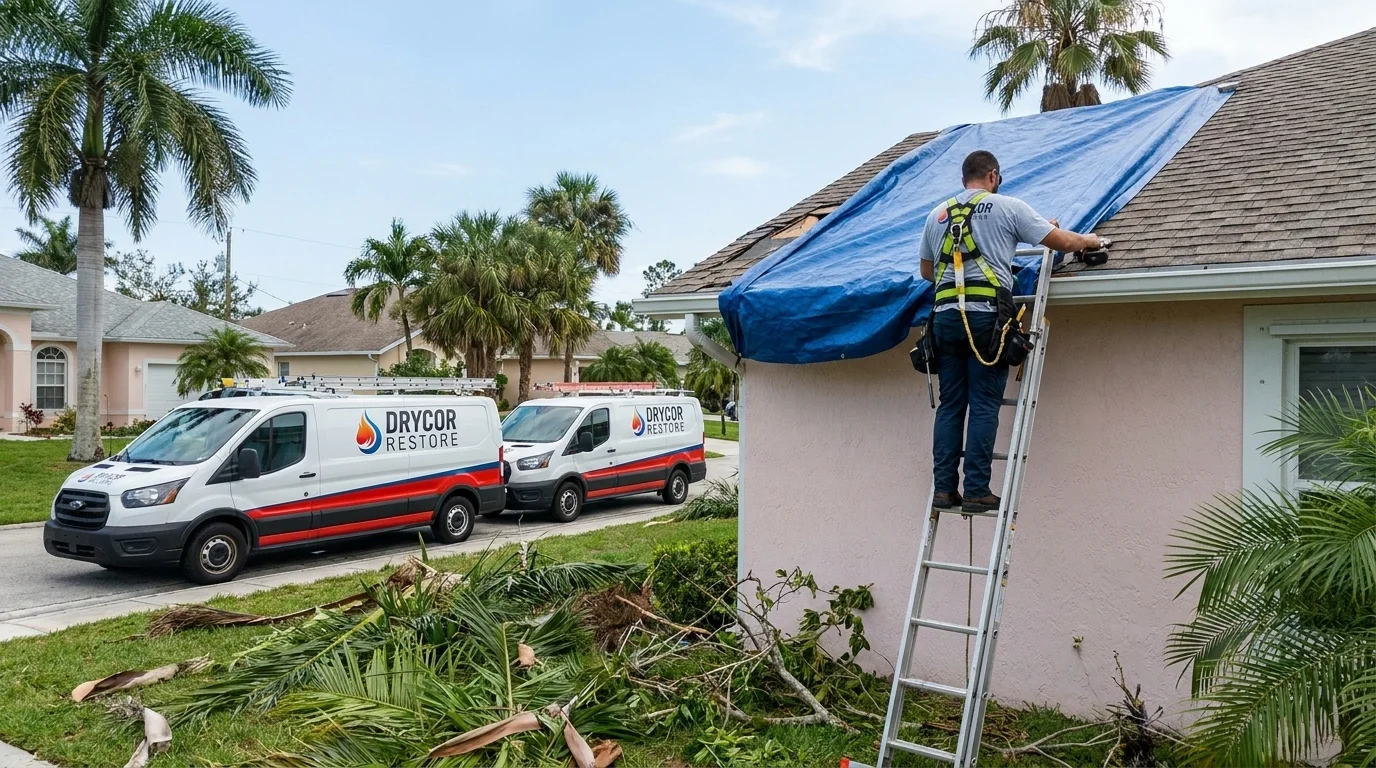
Storm Damage Restoration in Dundee
24/7 storm damage restoration in Dundee, FL. IICRC-certified, insurance billing accepted. Call (813) 829-1091.
Our IICRC-certified technicians are dispatched from our Thonotosassa, FL headquarters and are typically on-site in Dundee within 60 minutes of your call.
Dundee sits in the heart of Polk County, where the ridge lakes geography funnels summer thunderstorms and late-season hurricanes into a corridor that can drop several inches of rain in under an hour. When a fast-moving storm tears through, the damage rarely stops at a missing shingle: wind-driven rain finds every gap in aging soffits, water pools against foundations on the flat lots common throughout town, and the humidity that follows keeps everything wet long after the sky clears. If a storm has just hit your Dundee home, the window for limiting secondary damage is short.
Why Dundee Properties See Elevated Storm Damage Risk
Polk County’s ridge terrain creates a microclimate where storms stall and intensify more than coastal observers expect. Dundee’s position along the Lake Wales Ridge means properties on the eastern and western slopes drain differently: the sandy, well-draining soils near the ridge crest shed water quickly, but lower-lying lots closer to the chain of lakes can hold standing water for hours after a storm passes. That standing water is the real threat. Once it finds a path under a door threshold or through a cracked foundation stem wall, it begins saturating subfloor assemblies and wall cavities that look dry from the surface.
The housing stock here adds another layer of complexity. Many homes in Dundee were built in the 1970s and 1980s, when construction relied on wood-frame walls with little to no moisture barrier behind the exterior cladding. A wind-driven rain event at 60 mph pushes water through gaps that would never matter in a light shower. Older flat or low-slope roof sections, common on Florida ranch-style homes of that era, are especially vulnerable to debris punctures from downed citrus branches and palm fronds.
Our Storm Damage Restoration Process in Dundee
Every storm job starts with a structured assessment, not a quick visual walk-through. The crew documents wind and water intrusion points, uses thermal imaging to locate moisture hidden behind walls and ceilings, and maps affected materials before any equipment is staged. That documentation matters for your insurance claim and for making sure nothing is missed before drying begins.
Once the scope is clear, the process moves through four stages: emergency board-up or tarping of any open roof or wall sections, water extraction from flooring and cavities, structural drying calibrated to Florida’s ambient humidity levels, and final assessment of materials that need removal versus those that can be restored. Drying in Dundee’s climate requires more aggressive dehumidification than inland Northern states because the outdoor air pulling into the structure is already carrying significant moisture load. Equipment settings that work in a dry climate will underperform here.
As an IICRC Certified Firm, the team follows the S500 and S110 standards for water and storm damage drying, which sets specific benchmarks for moisture content in wood and drywall before a structure is considered dry. Those standards exist precisely because visual inspection alone misses the saturation that leads to mold colonization within 24 to 48 hours of a storm event.
Reaching Dundee from Thonotosassa
DryCor Restore operates 24/7 out of Thonotosassa, and Dundee is reachable via US-98 west through Lakeland and into Polk County’s ridge communities. The route is straightforward in normal conditions, and the team coordinates staging logistics by phone before arrival so that equipment is loaded for the specific loss type before the truck leaves the yard. If a major storm has impacted the broader Polk County area, the crew prioritizes contact with you to give an accurate arrival window rather than an optimistic estimate that doesn’t account for road debris or traffic.
Dundee Insurance Coordination
Storm damage claims in Florida carry specific documentation requirements that differ from a standard water loss. Wind versus water causation is a line that carriers examine closely, and having a detailed written scope with photographs taken before any materials are disturbed is the single most important thing you can do to protect your claim. The team provides that documentation as a standard part of the process, not as an add-on.
If your policy includes a separate hurricane or windstorm deductible, which is common for Polk County properties, the adjuster will want to see clear evidence of the point of entry and the path of water migration. Thermal images and moisture mapping readings support that narrative in a way that a general contractor’s repair estimate alone does not.
Local Note
Homes near the lower elevations of Dundee, particularly those on lots that back up to any of the small retention areas or drainage swales built into older subdivisions, often have a hidden vulnerability: the swales were sized for typical storm events, not for the kind of rainfall totals that a slow-moving tropical system can deliver. When those swales back up, water can sheet across yards and enter garages and utility rooms through gaps at the base of block walls that were never designed as a flood barrier. If your home is in one of those lower-lying sections, it is worth having the crew check the exterior foundation perimeter and garage threshold during the initial assessment, even if the obvious damage appears to be roof-related.
Call DryCor Restore at (813) 829-1091 any time after a storm hits your Dundee property. The sooner the assessment begins, the more material and cost can be saved before secondary damage sets in.
Serving Dundee from our Thonotosassa headquarters — ★ 5.0 · 23 Google reviews
“We have been working on our mold problem in our home for about a week with them and we are so grateful that we didn’t go with another “cheaper” company (it’s only cheaper because they aren’t doing the work right). If you are beginning your mold remediation experience you’ll learn quickly that a lot…” — Cora, July 2026Read our reviews on Google →
Storm Damage Restoration in Dundee: Service Coverage
Frequently Asked Questions
How fast can you arrive for storm damage restoration in Dundee?
How quickly can DryCor Restore reach Dundee after a storm call?
Does Polk County's hurricane deductible affect how storm claims are handled in Dundee?
Are the older ranch-style homes common in Dundee harder to dry after storm water intrusion?
What happens if storm water has been sitting in my Dundee home for more than a day before I call?
Can you handle both the emergency tarping and the full restoration, or do I need separate contractors in Dundee?
Will my homeowners insurance cover storm damage restoration in Dundee?
Storm Damage Restoration response in Dundee
Most Dundee calls see a technician on-site within 60 minutes from our Thonotosassa headquarters.