
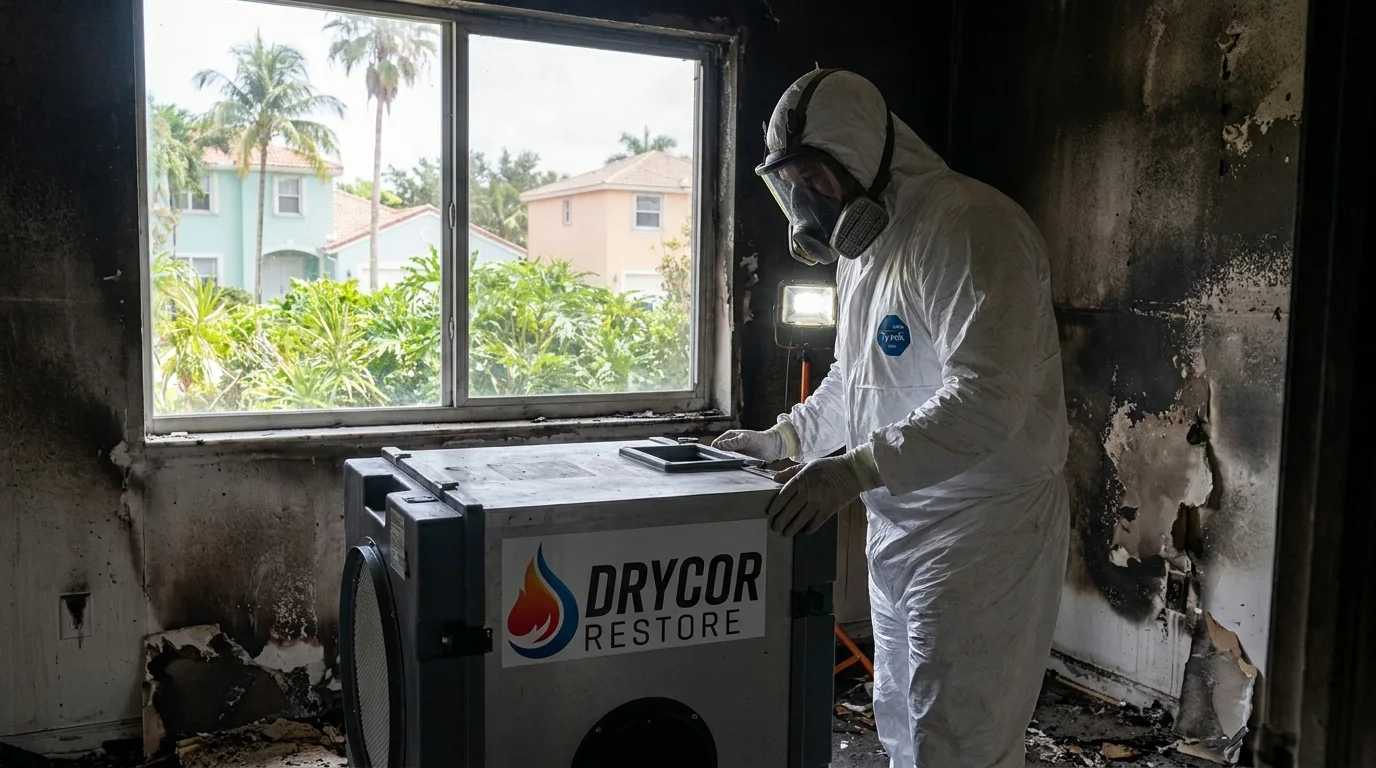
Fire Damage Restoration in Lake Wales
24/7 fire damage restoration in Lake Wales, FL. IICRC-certified, insurance billing accepted. Call (813) 829-1091.
Our IICRC-certified technicians are dispatched from our Thonotosassa, FL headquarters and are typically on-site in Lake Wales within 60 minutes of your call.
Lake Wales sits in the heart of Polk County, where the dry-season fire risk is real and the humidity that follows a fire can turn smoke-saturated walls into a secondary mold problem within days. When a kitchen fire, electrical fault, or wildland-interface spark damages a home here, the restoration timeline is shaped by factors that don’t apply everywhere: the region’s older housing stock, the clay-heavy soils that affect drainage around crawl spaces, and the subtropical climate that keeps structural materials damp long after the flames are out. DRYCOR RESTORE responds 24/7 and works through the full scope of fire and smoke restoration, from the first emergency board-up to the final coat of paint.
Why Lake Wales Properties Face Distinct Fire Damage Challenges
Polk County’s ridge communities, including Lake Wales, have a higher concentration of homes built between the 1940s and 1980s than many parts of the Tampa Bay region. Those older structures frequently have original wood-framed interiors, tongue-and-groove pine subfloors, and knob-and-tube or aluminum branch wiring that was common before modern electrical codes caught up. Aluminum wiring in particular is a documented fire-risk factor in homes of that era, and when it does cause a fire, the resulting char often penetrates deeper into framing members than it would in newer construction. Smoke from a slow-burning electrical fire also behaves differently than smoke from a fast kitchen grease fire: it carries more soot proteins, deposits a thicker oily film on surfaces, and embeds into porous materials like plaster and original hardwood at a molecular level that surface cleaning alone cannot address.
The local climate adds another layer. Lake Wales averages over 50 inches of rain per year, and the months immediately following the dry-season fire window bring intense humidity. A fire-damaged home with compromised roof decking or broken windows can absorb enough ambient moisture in 48 to 72 hours to create conditions where mold colonization begins, even before the smoke odor has been fully addressed. That overlap between fire damage and moisture intrusion is something the restoration plan has to account for from day one.
Our Fire Damage Restoration Process in Lake Wales
The work begins with stabilization: boarding openings, tarping the roof, and securing the structure so no additional weather or intrusion damage compounds the loss. From there, the process follows a documented sequence.
First, a room-by-room assessment identifies the burn zone, the smoke migration path, and any water damage left by suppression efforts. Sprinkler systems and fire hose discharge leave standing water that needs extraction before any drying or cleaning can begin. Next, structural materials are evaluated for salvageability. Char-damaged framing is documented for the insurance scope; materials that can be cleaned and restored are separated from those that require removal.
Smoke and soot cleaning is the most labor-intensive phase. Dry sponge methods remove loose soot before any wet cleaning begins, because introducing moisture to a heavy soot layer drives it deeper into porous surfaces. Chemical sponges, alkaline cleaners, and HEPA-filtered equipment are used in sequence depending on the surface type. Odor control follows, using thermal fogging and hydroxyl generation to neutralize smoke compounds in the air and inside structural cavities, not just on surfaces. The IICRC-certified team at DRYCOR RESTORE applies these standards to every fire loss regardless of size.
Finally, reconstruction begins once the structure is clean, dry, and documented. That can mean anything from replacing drywall in a single room to rebuilding a roof assembly, and the scope is coordinated directly with your insurance adjuster.
Reaching Lake Wales from Thonotosassa
DRYCOR RESTORE is based in Thonotosassa, and the route to Lake Wales runs south on US-92 and US-17 through Plant City and Bartow before reaching Polk County’s ridge communities. Because the team is available around the clock, a call at any hour puts a crew in motion. The drive covers roughly 60 miles depending on the specific address, and crews carry the board-up and extraction equipment needed to stabilize a loss on arrival rather than waiting for a second trip.
Insurance Coordination for Lake Wales Fire Claims
Fire losses in Florida are among the most document-intensive insurance claims a homeowner will file. DRYCOR RESTORE prepares a line-item scope of loss that matches the format adjusters and third-party estimators use, which reduces back-and-forth and keeps the claim moving. The team photographs every affected area before any material is removed, preserving the record your carrier needs to process the claim accurately. If a supplemental scope is needed after demolition reveals hidden damage, that documentation is prepared and submitted as part of the same coordinated process.
Local Note
Homes in the Lake Wales area that were built before the 1980s often have original plaster-over-wood-lath wall systems rather than drywall. After a fire, these walls present a specific challenge: the plaster itself may look intact and cleanable, but smoke and heat can travel through the lath gaps and deposit soot and odor compounds inside the wall cavity where no surface cleaning tool can reach. In those situations, selective demolition of the plaster is sometimes the only way to fully neutralize the odor and verify that the framing behind it is structurally sound. It is a more involved process than cutting out drywall, but skipping it typically means the smoke smell returns within weeks once the home is reoccupied and the HVAC system begins circulating air through those cavities again.
If you are dealing with fire or smoke damage in Lake Wales, call DRYCOR RESTORE at (813) 829-1091. The team is available 24/7, and the first step is a thorough assessment, not a sales pitch.
Serving Lake Wales from our Thonotosassa headquarters — ★ 5.0 · 23 Google reviews
“We have been working on our mold problem in our home for about a week with them and we are so grateful that we didn’t go with another “cheaper” company (it’s only cheaper because they aren’t doing the work right). If you are beginning your mold remediation experience you’ll learn quickly that a lot…” — Cora, July 2026Read our reviews on Google →
Fire Damage Restoration in Lake Wales: Service Coverage
Frequently Asked Questions
How fast can you arrive for fire damage restoration in Lake Wales?
How quickly can DRYCOR RESTORE reach a fire-damaged home in the Lake Wales area?
Does the older housing stock common in Lake Wales affect how fire damage restoration is handled?
Lake Wales gets heavy summer rainfall. Can a fire-damaged home develop mold before restoration is complete?
What does the smoke odor removal process actually involve, and how long does it take in a typical Lake Wales home?
How does DRYCOR RESTORE handle the insurance claim process for a fire loss in Lake Wales?
Fire Damage Restoration response in Lake Wales
Most Lake Wales calls see a technician on-site within 60 minutes from our Thonotosassa headquarters.