Sewage Cleanup and Sanitization in Safety Harbor
24/7 sewage cleanup and sanitization in Safety Harbor, FL. IICRC-certified, insurance billing accepted. Call (813) 829-1091.
Our IICRC-certified technicians are dispatched from our Thonotosassa, FL headquarters and are typically on-site in Safety Harbor within 60 minutes of your call.
Safety Harbor sits at the edge of Old Tampa Bay, and that geography shapes more than the view. The city’s low-lying terrain, aging sewer infrastructure in older residential pockets, and the region’s intense summer storm seasons combine to make sewage backups a recurring and genuinely hazardous problem here. When a sewer line reverses into a bathroom or a septic system overflows into a crawl space, the contamination is immediate and the window for safe remediation is short. DRYCOR RESTORE responds 24/7 from Thonotosassa, reaching Safety Harbor properties to begin containment and sanitization before secondary damage compounds the loss.
Why Safety Harbor Properties See Sewage Backup Issues
Pinellas County’s flat coastal topography gives stormwater and sewage nowhere to drain quickly. During heavy rain events, municipal sewer systems serving Safety Harbor can experience surcharge conditions, where the volume of water entering the system exceeds its capacity and pushes effluent backward through the lowest fixture in a home. Older homes closer to the waterfront and downtown core often have cast-iron or clay-tile lateral lines that have degraded over decades, making root intrusion and joint separation common failure points. Septic systems in areas that have not yet connected to municipal sewer are especially vulnerable after prolonged wet periods, when saturated soil loses its ability to absorb effluent from the drain field. The result is overflow that surfaces in yards, garages, and interior spaces.
Our Sewage Cleanup and Sanitization Process in Safety Harbor
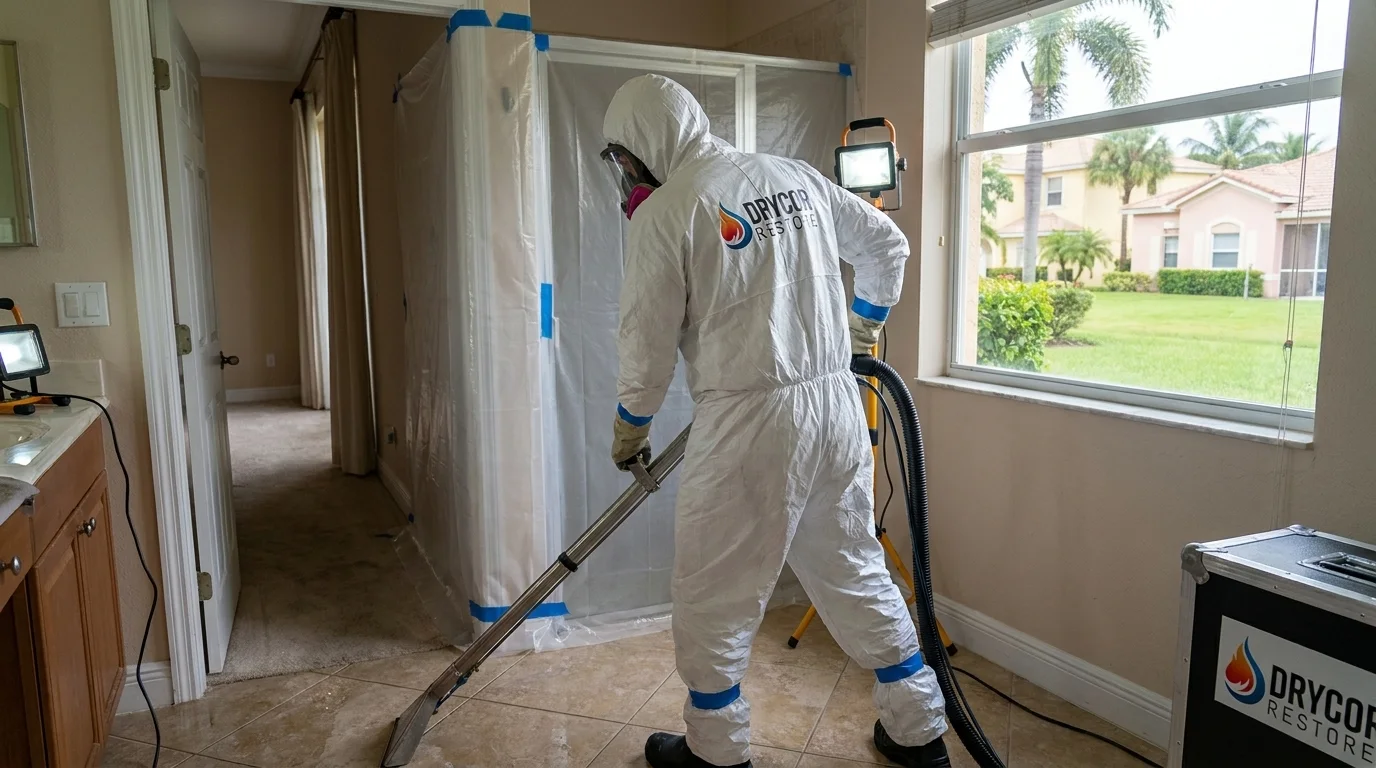
Sewage is classified as Category 3 water, the most contaminated classification in the IICRC S500 standard, meaning it carries pathogens, bacteria, and in some cases parasites. The process is not simply wet-vacuuming and mopping. DRYCOR RESTORE’s IICRC-certified team begins with containment, isolating the affected area to prevent cross-contamination to clean spaces. Porous materials that have absorbed raw sewage, including drywall, insulation, carpet, and subflooring, are typically removed rather than dried in place because drying does not eliminate biological contamination. Hard surfaces are treated with EPA-registered disinfectants, and the area undergoes structured drying monitored with calibrated moisture meters. Documentation of affected materials, moisture readings, and remediation steps is compiled throughout for insurance purposes.
Because many Safety Harbor homes were built in the 1950s through 1970s, crews are also alert to the presence of lead-based paint in disturbed materials. DRYCOR RESTORE holds EPA Lead-Safe certification, which matters when sewage cleanup requires removing older painted drywall or trim.
Reaching Safety Harbor from Thonotosassa
From DRYCOR RESTORE’s Thonotosassa headquarters, the primary route to Safety Harbor runs west on SR-60 through Brandon and into the Pinellas County corridor, or north and west via I-4 to I-275 south and across the Howard Frankland Bridge. Either path puts crews in Safety Harbor well within a practical emergency response window, and because service is available around the clock, a call at 2 a.m. after a sewer line backs up into a finished basement reaches the same trained team as a weekday morning call. Once on-site, crews familiar with Safety Harbor’s street layout can stage equipment efficiently, including on the narrower residential streets closer to the bay.
Safety Harbor Insurance Coordination
Sewage backup claims carry specific policy language that differs from standard water damage coverage. Many homeowners discover after the fact that their base policy excludes sewer backup unless a rider was added. DRYCOR RESTORE documents the loss thoroughly from the moment the crew arrives, including photographs of affected materials, moisture readings, and a written scope of damage, so that whether your carrier covers the loss fully, partially, or requires a supplemental claim, the paperwork supports your position. The team can communicate directly with adjusters and works with most major carriers. If coverage is limited, the documentation also supports any dispute or appeal process.
Local Note
Safety Harbor’s proximity to Old Tampa Bay means the water table in lower-elevation neighborhoods can sit surprisingly close to the surface, particularly after the area receives the kind of multi-inch rainfall that arrives with Gulf-fed storm systems in late summer and early fall. When a septic system or sewer lateral fails during or just after one of these events, the surrounding soil is often already at or near saturation. That condition slows the drying process for exterior-adjacent spaces like garages, utility rooms, and slab-on-grade floors because moisture is being drawn in from the ground even as drying equipment works from the interior. Crews account for this by extending drying cycles and monitoring perimeter readings separately from interior readings, rather than calling a space dry based on surface readings alone.
If a sewage backup has affected your Safety Harbor home or commercial property, the safest step is to keep people and pets out of the contaminated area and call DRYCOR RESTORE at (813) 829-1091. Category 3 contamination does not become safer with time, and the longer porous materials remain saturated, the more extensive the removal scope becomes.
Serving Safety Harbor from our Thonotosassa headquarters — ★ 5.0 · 23 Google reviews
“The Showalter Construction and Restoration Team as well as DryCor Restore have been a Great Help and Excellent Experience. From Initial assessment, Insurance navigation, Expert Advice, Execution of Restore have been spot on ! The Crew of Victor, Victor, Damen and Garrett are the best, Hard working…” — Mark, June 2026Read our reviews on Google →
Sewage Cleanup and Sanitization in Safety Harbor: Service Coverage
Frequently Asked Questions
How fast can you arrive for sewage cleanup and sanitization in Safety Harbor?
How quickly can DRYCOR RESTORE reach a sewage backup emergency in Safety Harbor?
Does Safety Harbor's high water table affect how long sewage cleanup and drying takes?
Are older Safety Harbor homes built in the mid-20th century at higher risk for sewer line backups?
What does the sewage sanitization process actually involve, and what gets removed versus cleaned?
Does a standard homeowner policy in Safety Harbor cover septic overflow or sewer backup cleanup?
Will my homeowners insurance cover sewage cleanup and sanitization in Safety Harbor?
Sewage Cleanup and Sanitization response in Safety Harbor
Most Safety Harbor calls see a technician on-site within 60 minutes from our Thonotosassa headquarters.