
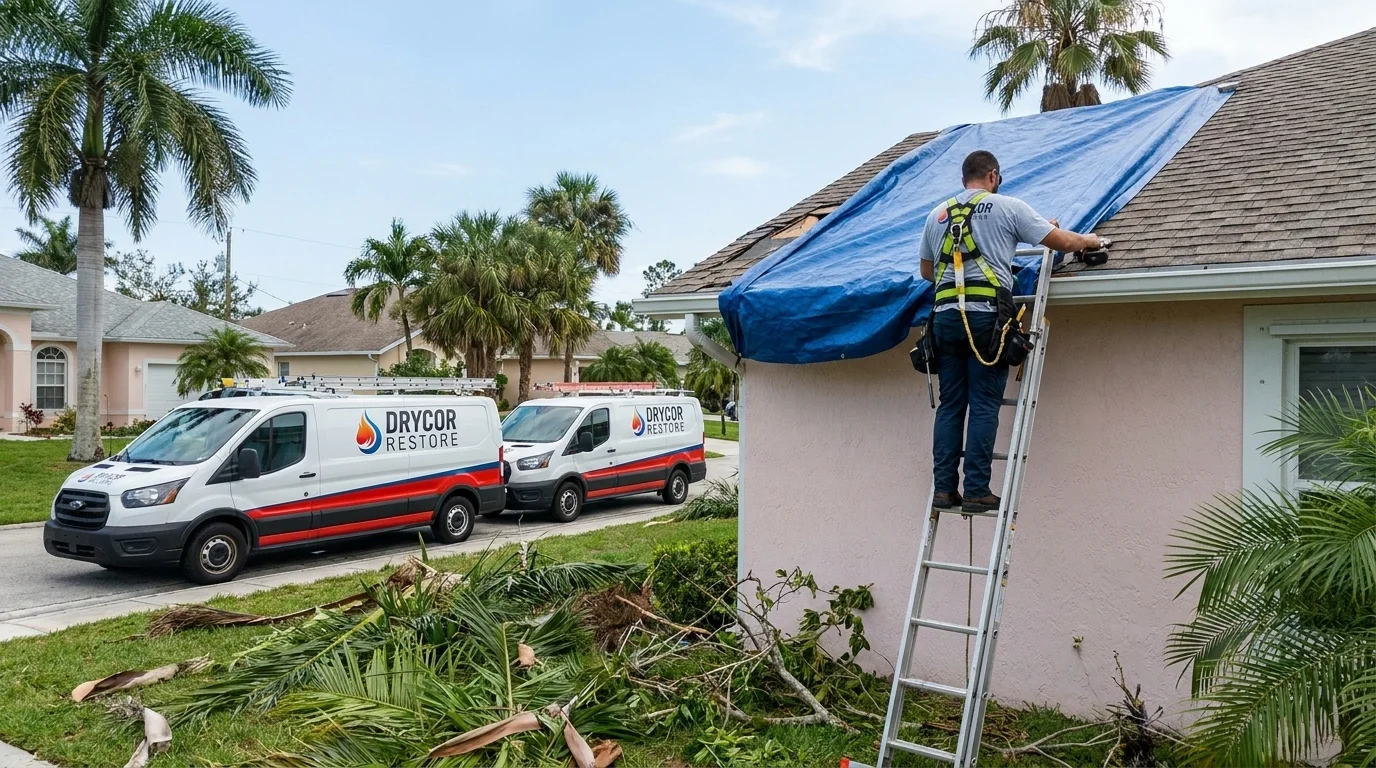
Storm Damage Restoration in St. Pete Beach
24/7 storm damage restoration in St. Pete Beach, FL. IICRC-certified, insurance billing accepted. Call (813) 829-1091.
Our IICRC-certified technicians are dispatched from our Thonotosassa, FL headquarters and are typically on-site in St. Pete Beach within 60 minutes of your call.
St. Pete Beach sits on a narrow barrier island where Gulf storms don’t just pass through, they arrive with surge, wind, and rain hitting simultaneously from multiple directions. When a named storm or a fast-moving squall tears through, the damage rarely stops at a broken shingle. Water finds every gap in aging stucco, wind-driven rain saturates wall cavities within hours, and sand-laden surge leaves behind a residue that accelerates corrosion in ways that inland Florida properties simply don’t face. If your home or rental unit took a hit, the window to prevent secondary damage is short.
Why St. Pete Beach Properties Are Especially Vulnerable to Storm Damage
The barrier island geography that makes St. Pete Beach desirable is the same geography that concentrates storm risk. Properties here face Gulf-side wind exposure with minimal natural buffer, and the island’s low elevation means even a modest surge event can push water under doors, through crawl spaces, and into ground-floor units before the storm has passed.
Much of the housing stock along the island was built in the 1950s through 1970s, when construction standards for wind uplift and water intrusion were far less stringent than today’s Florida Building Code requirements. Flat or low-slope roofs common in that era are particularly prone to membrane failure under sustained wind pressure. Jalousie windows, still present in some older cottages and duplexes, offer almost no resistance to wind-driven rain. Once water is inside those wall assemblies, it moves laterally through fiberglass batt insulation and can reach interior framing and drywall long before any visible staining appears at the surface.
Salt air compounds the problem. Fasteners, flashing, and metal roof components corrode faster here than anywhere inland, meaning what looked like a secure connection before the storm may have been compromised for years. A tree strike or high-wind event can expose those weaknesses all at once.
Our Storm Damage Restoration Process in St. Pete Beach
Every storm response starts with a systematic damage assessment before any material is removed or covered. Moisture readings are taken at the wall, floor, and ceiling plane using thermal imaging and calibrated meters, because water behind stucco or under tile reads dry at the surface while the substrate stays saturated. Structural damage is documented photographically at the same time, creating a clear record for your insurance adjuster.
Once the scope is established, the sequence matters. Tarping and board-up happen first to stop additional weather intrusion. Wet insulation, compromised drywall, and saturated flooring are removed promptly because they cannot be dried in place and become a mold substrate within 24 to 48 hours in St. Pete Beach’s humidity. Industrial drying equipment is then deployed and monitored daily against target moisture baselines, following IICRC S500 and S520 standards. Reconstruction planning begins in parallel so there is no gap between the drying phase and the rebuild.
As an IICRC Certified Firm, DRYCOR RESTORE documents every phase in writing, which matters when your carrier’s adjuster reviews the claim or when a Pinellas County building inspection is required before walls are closed.
Reaching St. Pete Beach from Thonotosassa
DRYCOR RESTORE operates 24/7, and St. Pete Beach is reachable from the Thonotosassa area via I-275 South across the Howard Frankland Bridge, then south through St. Petersburg to the Corey Causeway or the Pinellas Bayway into the island. During a named storm event, route conditions and bridge closures can affect timing, so our team monitors road status actively and communicates estimated arrival directly. Call (813) 829-1091 any time, day or night, and you will reach a live person, not a voicemail.
St. Pete Beach Insurance and HOA Coordination
Storm damage claims in coastal Pinellas County often involve Citizens Property Insurance or specialty wind carriers, and those policies frequently have separate wind and flood deductibles that affect how the loss is divided. DRYCOR RESTORE documents damage in the format adjusters need: itemized moisture logs, photographic evidence organized by area, and scope-of-work estimates that align with industry pricing standards. We communicate directly with your adjuster throughout the process so you are not translating between a contractor and an insurance company on your own.
If your property is part of a condominium association or a managed community, HOA approval for exterior repairs, roofing, or structural work may be required before work begins. We are familiar with that coordination layer and can provide documentation packages that satisfy association management requirements.
Local Note
Properties on the Gulf-front side of St. Pete Beach, particularly those with direct beach exposure, often have stucco exteriors that have been repainted multiple times over the decades. After a storm, water that enters through cracked or failed stucco can become trapped between paint layers and the original substrate, creating a pocket of moisture that standard surface readings will miss entirely. Thermal imaging during the initial assessment is the only reliable way to locate these hidden wet zones before they become a mold problem behind an otherwise intact-looking wall. It is a detail that matters specifically here, where salt-air weathering has been working on those exterior surfaces for 40 or 50 years.
If your property sustained storm damage, call DRYCOR RESTORE at (813) 829-1091. The team is available around the clock, and the sooner the assessment begins, the more of your structure and contents can be saved.
Serving St. Pete Beach from our Thonotosassa headquarters — ★ 5.0 · 23 Google reviews
“The Showalter Construction and Restoration Team as well as DryCor Restore have been a Great Help and Excellent Experience. From Initial assessment, Insurance navigation, Expert Advice, Execution of Restore have been spot on ! The Crew of Victor, Victor, Damen and Garrett are the best, Hard working…” — Mark, June 2026Read our reviews on Google →
Storm Damage Restoration in St. Pete Beach: Service Coverage
Frequently Asked Questions
How fast can you arrive for storm damage restoration in St. Pete Beach?
How does St. Pete Beach's barrier island location affect storm damage compared to mainland Pinellas properties?
My St. Pete Beach home was built in the 1960s. Does that affect how storm damage restoration is handled?
Can DRYCOR RESTORE help coordinate with Citizens Property Insurance or a specialty wind carrier after a St. Pete Beach storm?
What does the storm damage assessment process look like when you arrive at a St. Pete Beach property?
How quickly can mold become a concern after storm damage in St. Pete Beach's climate?
Storm Damage Restoration response in St. Pete Beach
Most St. Pete Beach calls see a technician on-site within 60 minutes from our Thonotosassa headquarters.