Industrial Restoration in Thonotosassa
24/7 industrial restoration in Thonotosassa and surrounding areas. IICRC-certified, insurance billing accepted. Call (813) 829-1091.
A warehouse with 40,000 square feet of open floor space doesn’t dry the way a house does. Water from a burst sprinkler line or a failed roof drain spreads under racking, soaks into slab joints, and sits beneath inventory pallets long after the surface looks dry. Manufacturing floors have the same problem with soot after an electrical fire: it settles into machinery housings and control panels where a standard clean won’t reach it. Industrial restoration deals with scale, downtime cost, and equipment that can’t just be thrown out and replaced with a trip to the hardware store.
What Industrial Restoration actually involves
Industrial and commercial-scale losses, whether from water, fire, or storm intrusion, require different math than a residential job. The square footage is larger, the ceiling heights change how air moves, and there’s usually production equipment, inventory, or racking systems in the way of a straightforward dry-out. Drying a warehouse means positioning desiccant or LGR dehumidifiers to cover cubic footage, not just room size, and running moisture meters across concrete slabs that can hold water in control joints for weeks if they’re missed. On a fire loss, soot characterization matters even more in a plant setting because synthetic materials, lubricants, and chemical stock burn differently than a house fire and leave different residues on equipment surfaces. Timelines run longer than residential work, often measured in weeks rather than days, because the goal is getting the facility operational again without a callback for hidden moisture or corrosion six months later.
Our process
- Facility assessment and hazard mapping. Before any equipment goes in, we walk the affected zones with moisture meters and thermal imaging to map how far the water or smoke actually traveled, including under racking, through wall cavities, and into HVAC returns. OSHA-trained crews flag electrical and mechanical hazards before work starts.
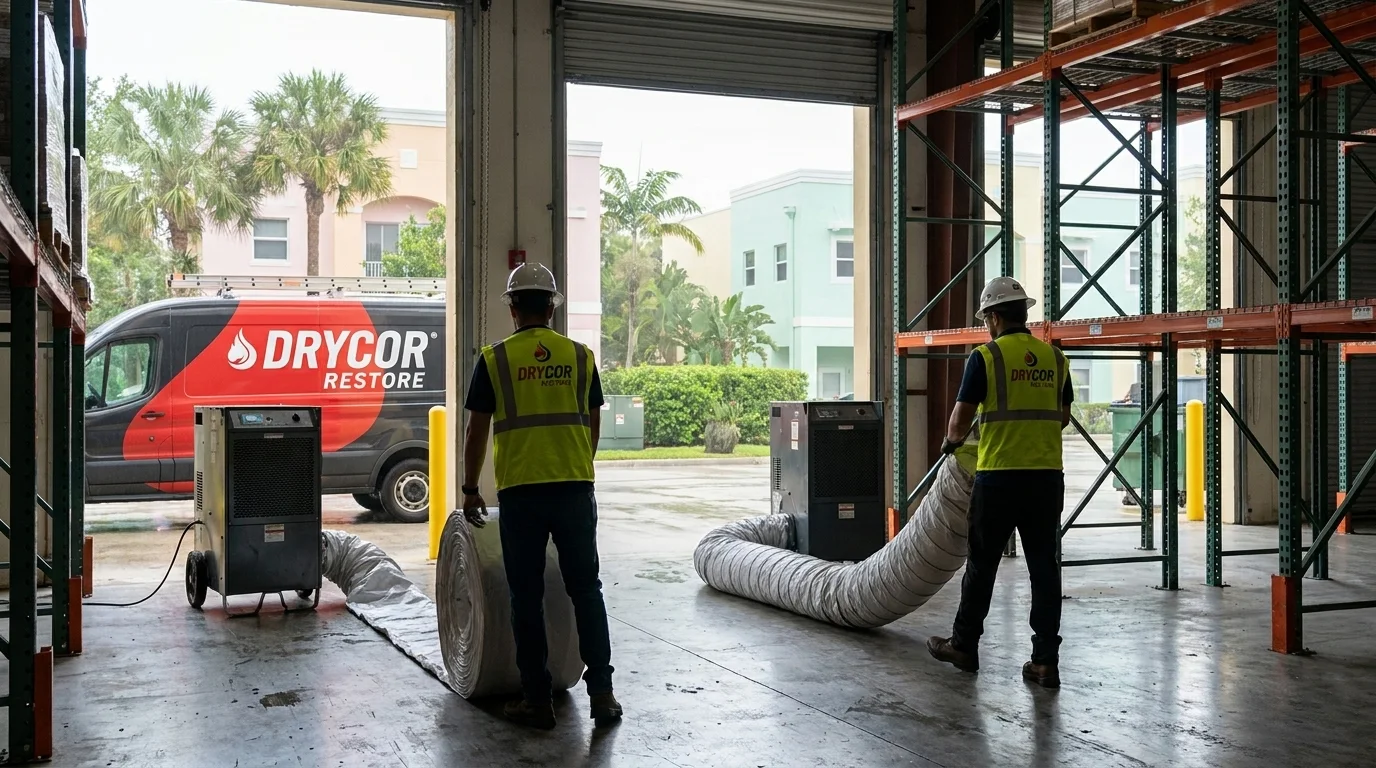
- Containment and phased drying. Rather than shutting down an entire facility, we section off affected zones so unaffected production areas can keep running. Desiccant dehumidification is sized to the actual cubic footage of the space, not guessed at.
- Moisture and air monitoring across the structure. Slabs, racking bases, and wall assemblies get tracked daily with documented readings. This is also where ductwork gets checked, since contaminated air handling can spread soot or moisture into parts of the building that never saw direct damage.
- Equipment and inventory evaluation. Machinery, control panels, and stock get assessed for what’s salvageable with cleaning versus what needs replacement, documented for the facility’s insurance adjuster and risk manager.
- Reconstruction and reinstallation coordination. Once the space reads dry or clean, we coordinate with facility engineers and contractors on flooring, drywall, or equipment reinstallation so the return to production happens on a known schedule, not an open-ended one.
What separates a good industrial restoration response from a bad one
The biggest mistake on large-loss jobs is treating square footage like a bigger version of a house job: more air movers, same approach. It doesn’t work. Desiccant dehumidification sized for open warehouse volume behaves differently than refrigerant-based units, and using the wrong equipment class means a space reads dry on the surface while concrete and steel framing stay wet underneath. Another common miss is skipping HVAC and ductwork inspection after a fire or flood, which lets soot or moisture recirculate into clean areas weeks later. Adjusters reviewing industrial claims also look closely at documented moisture logs and photos tied to specific zones, not a single blanket “dried” sign-off, because business interruption coverage often hinges on proof of when each section of the facility was actually safe to reoccupy.
What does Industrial Restoration cost?
Industrial and commercial-scale losses vary enormously depending on square footage, whether production equipment was affected, and how much inventory is involved. The ranges below reflect typical industry figures for commercial-scale jobs, not a quote, and every facility gets a written scope before work begins so there are no surprises on invoicing. Commercial property insurance often covers the structure, fixed equipment, and sometimes business interruption, but coverage for inventory and stock depends heavily on the specific policy.
| Scenario | Typical range |
|---|---|
| Localized warehouse water intrusion, single zone | $5,000 - $15,000 |
| Manufacturing floor water damage with affected equipment | $15,000 - $50,000 |
| Warehouse fire and smoke damage, partial facility | $50,000 - $150,000 |
| Large plant flood with inventory and racking loss | $100,000 - $300,000+ |
| Emergency board-up or tarping for a damaged loading dock or roof | $1,500 - $5,000 |
Seasonal & regional considerations
Thonotosassa and the surrounding Tampa Bay industrial corridor see heavy summer thunderstorm activity and hurricane-season risk from roughly June through November, and flat industrial roofs are especially prone to ponding and leak points during that stretch. Large open warehouse spaces also hold humidity differently than homes, so even a minor roof leak can push interior conditions into a range where corrosion on metal racking or equipment becomes a real concern within days, not weeks.
Service area
DRYCOR RESTORE works industrial and commercial losses across Thonotosassa and the surrounding Tampa Bay area, including Plant City, Lutz, Zephyrhills, and the industrial corridors nearer Tampa. Crews are IICRC Certified and OSHA trained, licensed under CBC1253966, and available 24/7 for facilities that can’t afford an open-ended timeline on getting back into production.
If water, fire, or storm damage has taken a warehouse, plant, or manufacturing floor offline, call DRYCOR RESTORE at (813) 829-1091 to get a facility assessment started and a written scope of work moving.
Frequently Asked Questions
Does commercial or industrial insurance cover this type of restoration?
How is drying a warehouse different from drying a house?
Can part of our facility stay operational during the restoration work?
What happens to machinery and equipment after a water or fire loss?
Do you check HVAC and ductwork after an industrial fire or flood?
Looking for the best industrial restoration company in Thonotosassa?
DRYCOR RESTORE provides licensed and insured industrial restoration in Thonotosassa, FL and the surrounding area, and has served local property owners since 2005. Customers rate us 5.0 out of 5 stars on Google. We answer calls 24/7 — call (813) 829-1091 for immediate help.
Need Industrial Restoration now?
We respond 24/7 across Thonotosassa and surrounding FL cities.