
Storm Damage Restoration in Lake Wales
24/7 storm damage restoration in Lake Wales, FL. IICRC-certified, insurance billing accepted. Call (813) 829-1091.
Our IICRC-certified technicians are dispatched from our Thonotosassa, FL headquarters and are typically on-site in Lake Wales within 60 minutes of your call.
Lake Wales sits squarely in the heart of Polk County, where summer thunderstorms can drop several inches of rain in under an hour and where the ridge geography that gives the area its elevation also channels wind in unpredictable ways during tropical systems. When a storm tears through, the damage rarely stops at a missing shingle: water follows the breach, soaks into wall cavities, and begins working on framing and insulation before the clouds have cleared. DRYCOR RESTORE responds around the clock from Thonotosassa, bringing the equipment and IICRC-certified process needed to stop the damage from compounding.
Why Lake Wales Properties Are Particularly Vulnerable to Storm Damage
The ridge country around Lake Wales is beautiful, but it creates real exposure. Properties on elevated lots take the full force of wind that has nothing to block it, while lower-lying areas near the chain of lakes deal with sheet-flow flooding when storm drains and swales reach capacity quickly. Polk County’s soils shift between well-drained sandy ridges and poorly drained flatwoods clay, and a home’s drainage behavior during a storm depends heavily on which soil type sits under its yard.
The local housing stock adds another layer of complexity. Lake Wales has a significant number of homes built between the 1940s and 1970s, when concrete block construction was the regional standard. CBS (concrete block and stucco) walls hold up well to wind but are highly susceptible to moisture intrusion once the stucco surface is cracked or breached by storm debris. Water that enters a CBS wall can wick laterally through the block cores and show up as staining or efflorescence far from the original entry point, making the source harder to trace without moisture mapping equipment.
Citrus groves and large canopy oaks are common throughout the area, and both become hazards in a strong storm. Falling limbs and uprooted trees cause roof punctures, broken windows, and compromised soffits that let wind-driven rain enter attic spaces and travel down interior wall assemblies.
Our Storm Damage Restoration Process in Lake Wales
The first step on any storm loss is a thorough damage assessment before any material is moved or removed. We photograph and document every affected surface, which matters both for structural decision-making and for the insurance claim file. Thermal imaging and calibrated moisture meters let us map water migration inside walls and under flooring without unnecessary demolition.
Once the scope is clear, the work moves in a logical sequence:
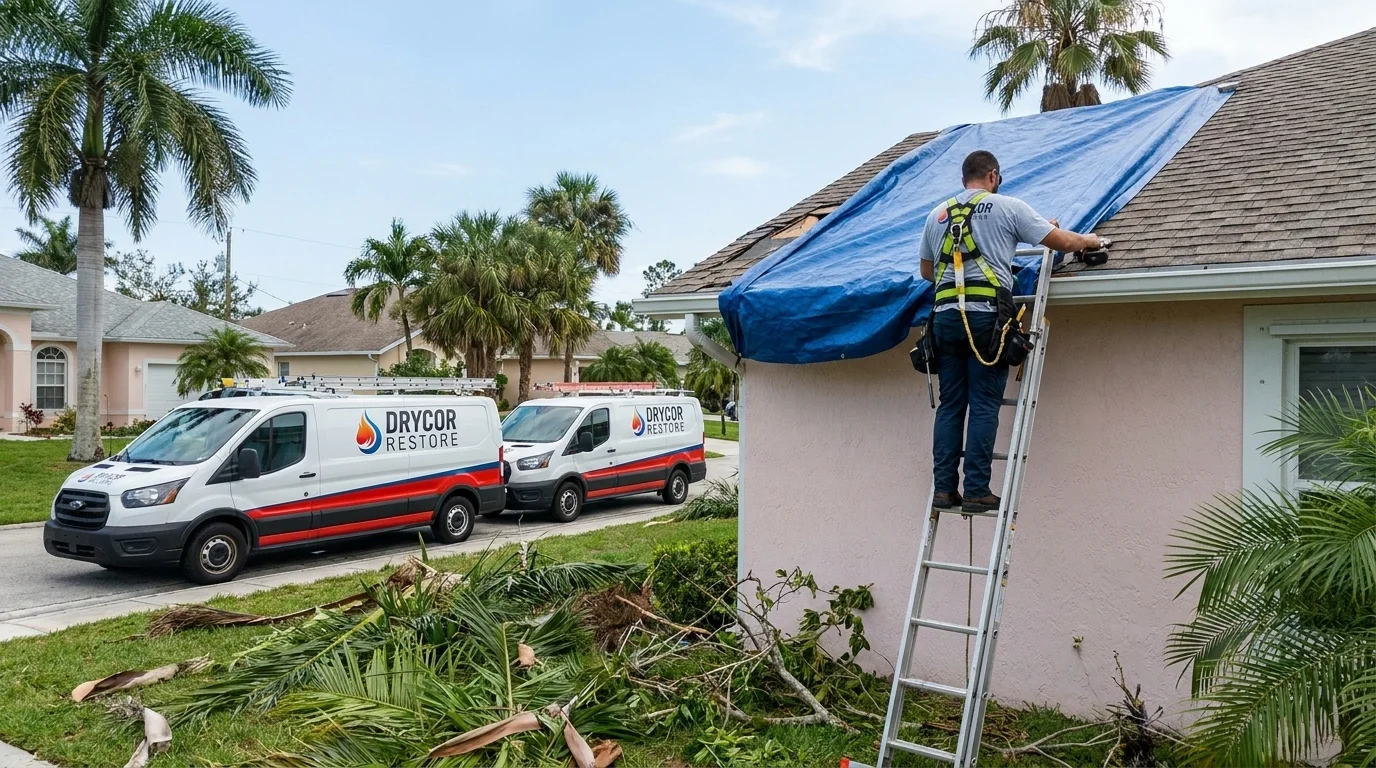
- Emergency stabilization: tarping compromised roof sections, boarding broken windows, and securing any structural elements at risk of further movement.
- Water extraction and drying: standing water comes out first, followed by the placement of industrial air movers and low-grain refrigerant dehumidifiers calibrated to Florida’s high ambient humidity. Drying in Central Florida’s climate requires more dehumidification capacity than drier regions because the outdoor air trying to equalize with the structure carries significant moisture load of its own.
- Debris and damaged material removal: storm-damaged insulation, compromised drywall or plaster, and saturated flooring are removed to the extent necessary to allow structural components to dry and to prevent secondary mold colonization, which can begin within 24 to 48 hours of a water intrusion event in Florida’s heat.
- Structural drying verification: we do not close a job on visual inspection alone. Moisture readings are logged daily and compared against baseline readings for the material type until all assemblies reach acceptable levels.
- Reconstruction coordination: once the structure is dry and stable, we coordinate or perform the repairs needed to return the home to pre-loss condition, working under license #CBC1253966.
Reaching Lake Wales from Thonotosassa
Our Thonotosassa base puts us on US-92 and then I-4 to reach Polk County, with US-27 south as the primary corridor into Lake Wales. Because we operate 24/7, a call at 2 a.m. after a fast-moving squall line moves through gets the same response as a midday call. We carry storm-response equipment on our service vehicles so the first crew on-site can begin stabilization and extraction without waiting for a second trip.
Lake Wales Insurance Coordination
Most storm losses in this area are homeowner’s insurance claims, and the documentation phase of our process is built with that in mind. We produce a detailed scope of loss, including moisture logs, photographs, and a written narrative, that gives your adjuster what they need to evaluate the claim accurately. We communicate directly with carriers and their field adjusters throughout the process so you are not left translating between the restoration crew and the insurance company.
Local Note
Homes along the older sections of Lake Wales built on the ridge often have original clay tile or barrel tile roofing. These roofs are durable under normal conditions, but individual tiles crack or dislodge in high-wind events, and the underlayment beneath them degrades over decades. A storm that looks minor from the street can have opened a significant pathway for water into the attic. We pay particular attention to attic moisture readings on tile-roof homes in this area because the entry point is rarely visible from a standard exterior walk-around.
If a storm has left your Lake Wales home with a breached roof, standing water, or damage you are not sure how to assess, call DRYCOR RESTORE at (813) 829-1091. We are available around the clock, and the sooner the structure is stabilized, the more of it can be saved.
Serving Lake Wales from our Thonotosassa headquarters — ★ 5.0 · 23 Google reviews
“We have been working on our mold problem in our home for about a week with them and we are so grateful that we didn’t go with another “cheaper” company (it’s only cheaper because they aren’t doing the work right). If you are beginning your mold remediation experience you’ll learn quickly that a lot…” — Cora, July 2026Read our reviews on Google →
Storm Damage Restoration in Lake Wales: Service Coverage
Frequently Asked Questions
How fast can you arrive for storm damage restoration in Lake Wales?
How quickly can DRYCOR RESTORE reach Lake Wales after a storm?
Does the concrete block construction common in older Lake Wales homes change how storm water damage is handled?
Lake Wales had a fast-moving storm last night and I am not sure if my roof was actually breached. Should I call now or wait to see if water shows up inside?
Will you handle the insurance documentation for a storm claim on my Lake Wales property?
What makes storm drying in Lake Wales different from drying in a drier climate?
Storm Damage Restoration response in Lake Wales
Most Lake Wales calls see a technician on-site within 60 minutes from our Thonotosassa headquarters.